What Is Robotics? Guide to the Best Robotics Classes in Surat
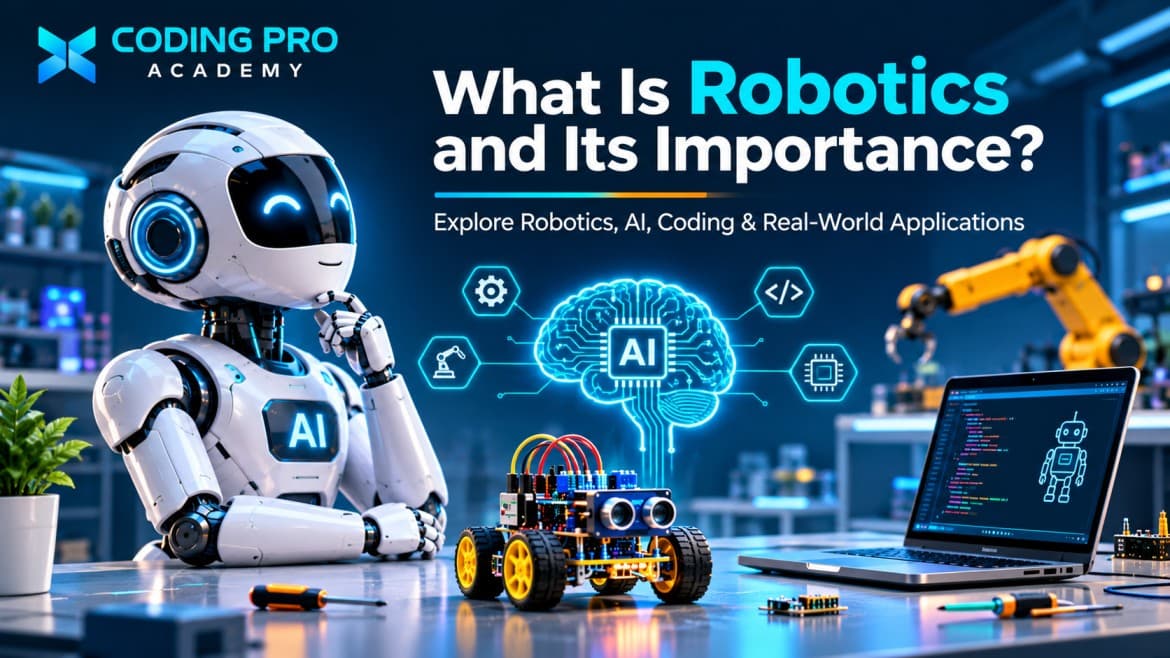
What Is Robotics? Importance in Education and the Best Robotics Classes in Surat
Ask a child to describe a robot and you will usually hear about a metal figure that walks and talks. Real robots look very different. Some are arms bolted to a factory floor, some are small cars that follow a black tape, and some are vacuum cleaners that bump their way around a living room. What they share is not their shape but their ability to sense, decide and move on their own. This guide explains what robotics really is, why schools and parents are paying attention to it, and what to look for if you are searching for the best robotics classes in Surat for your child.
What Is Robotics?
Robotics is the study and practice of creating machines that can carry out a job by themselves, or with only a little help from a person. Building such a machine means mixing several subjects at once: mechanics for the body, electronics for the wiring, coding for the decisions, and mathematics for measuring distances, angles and speed.
A useful way to think about it is this: a fan only spins when you press a switch, but a robot fan could notice that the room is warm, decide that cooling is needed, and switch itself on. That small step from "follows a button" to "reacts to its surroundings" is what turns an ordinary machine into a robot.
How Do Robots Work?
Whether it costs a few hundred rupees or several crores, almost every robot is built from the same five building blocks:
- Sensors — the robot's eyes, ears and skin. An ultrasonic sensor, for example, sends out sound waves and times the echo to judge how far away a wall is.
- Controller — a small computer board, such as an Arduino, that reads the sensors and runs the program.
- Motors and actuators — the muscles that spin wheels, open a gripper or lift an arm.
- Power source — usually a rechargeable battery pack for student robots.
- Program — the written instructions that tell the controller what to do with each reading.
Put together, these parts repeat a simple cycle again and again: read the sensor, make a decision, move. A student's first obstacle-avoiding car does exactly this many times every second, and so does a warehouse robot moving parcels.
Types of Robots
Robots are easiest to understand when grouped by the work they are designed for:
- Industrial robots — fixed arms that weld, paint and assemble on production lines.
- Service robots — machines that help people directly, like floor cleaners and restaurant delivery trolleys.
- Medical robots — systems that give surgeons steadier control or help patients practise movements during recovery.
- Mobile robots — wheeled robots and drones that move from place to place and find their own path.
- Humanoid robots — robots shaped like people, mostly used for research into balance and interaction.
- Collaborative robots (cobots) — lighter robots made to share a workspace safely with human workers.
- Exploration robots — rovers and underwater vehicles sent where people cannot easily go.
- Educational robots — kits that let students build, wire and program a working model.
Applications of Robotics Around Us
You do not need to visit a laboratory to see robotics at work. Car plants in Gujarat use robotic arms for welding and painting. Large e-commerce warehouses use small mobile robots to bring shelves to packing staff. Hospitals in bigger cities use robot-assisted systems for certain surgeries. Farmers are starting to use drones to survey and spray fields. Even ISRO's Pragyan rover, which explored the Moon during Chandrayaan-3, is a robot built and programmed by Indian engineers.
Each of these examples follows the same sense, decide and move cycle that students learn on a classroom kit — just at a much larger scale.
Importance of Robotics in Education
Most school subjects are learned on paper. Robotics is learned with hands, eyes and a bit of trial and error. When a student's robot drives off the table instead of stopping at the edge, nobody needs to explain that something went wrong — the student can see it, and then has to work out why.
This is why robotics has become a key part of STEM education in Surat and across India. Good robotics training for students builds:
- Practical understanding of science and maths, because formulas turn into real speed, distance and angles.
- Problem-solving, because every project involves finding and fixing at least one mistake.
- Step-by-step thinking, because a robot only does exactly what it is told, in the order it is told.
- Creativity, because students can redesign and improve their own models.
- Teamwork, because building, wiring and coding are easier when the work is shared.
- Confidence with technology, because children move from using gadgets to building them.
Robotics for school students also gives quieter learners a different way to shine. A child who struggles with long written answers may be the first in the class to get a line-follower running smoothly.
Robotics and Programming: Why Coding Comes First
Motors and sensors are only half of a robot. Without a program, the controller has no idea what to do with the readings it receives. Robotics and programming are therefore learned together: every time a student wants the robot to behave differently, the change happens in the code.
A typical learning path for a robotics course for kids looks like this:
- Block-based coding (Scratch or Blockly style) to understand sequences, loops and conditions without typing.
- Arduino programming, which is based on C/C++, to control real sensors, LEDs and motors.
- Python, for older students who want to move towards automation, computer vision and AI.
Students who enjoy this side of robotics can go deeper through our best coding classes in Surat and programming classes in Surat.
Robotics Projects for Students
The quickest way to learn robotics for beginners is to build something that works on the first day and improve it every week. Popular first projects include:
- Obstacle-avoiding car — turns away when the ultrasonic sensor spots something ahead.
- Line-following robot — uses infrared sensors to track a dark line on a light floor.
- Smart dustbin — lifts its lid with a servo motor when a hand comes close.
- Automatic night lamp — switches on by itself when a light sensor detects darkness.
- Phone-controlled car — driven over Bluetooth from a mobile app.
Each of these robotics projects for students introduces one new idea, so that by the end of a term a student has learned sensors, motors, decisions and wireless control without feeling overloaded.
Robotics vs Artificial Intelligence
The two terms are often used as if they mean the same thing, but they do not. Robotics is about the physical machine — its body, wiring and movement. Artificial intelligence is about software that learns from data and makes predictions, and it can run on an ordinary laptop with no motors at all.
The exciting part is where they meet. A robot with a camera and an AI model can recognise a ripe tomato and pick it, or spot a person and stop moving. Students who first understand how a basic robot works find it much easier to understand what AI adds on top.
| Point | Robotics | Artificial Intelligence |
|---|---|---|
| What it deals with | The physical machine: body, wiring and movement | Software that learns from data and makes predictions |
| Needs motors and sensors? | Yes | No, it can run on an ordinary laptop |
| Simple example | A car that stops before hitting a wall | An app that recognises faces in photos |
| When combined | A robot that sees a ripe tomato and picks it | |
Future of Robotics
Over the next decade, robots are expected to become cheaper, smaller and better at working next to people. Cobots are already entering smaller workshops, delivery drones are being tested in Indian cities, and AI is helping robots handle situations they were never specifically programmed for.
This is opening careers in robotics engineering, automation, embedded systems, mechatronics, computer vision and AI. But even students who choose a completely different career will benefit from the habits robotics builds: breaking down problems, testing ideas and not giving up after the first failure.
How to Choose the Best Robotics Classes in Surat
When you search for robotics classes near me, you will find many options. Before you decide, check these points:
- Does every student get to build with real kits, or do they mostly watch demonstrations?
- Is coding taught in every project, or is the course only about assembling parts?
- Are there separate levels for younger and older children?
- Will your child finish each module with a working project they can show you?
- Can the trainer explain why a robot failed, not just fix it for the student?
- Does the syllabus include current tools such as Arduino and beginner AI concepts?
A short demo class is the best way to judge these. Watch whether your child is actually building and coding, or simply following along.
Best Robotics Classes in Surat at Coding Pro Academy
Coding Pro Academy is a robotics learning academy in Surat built around one idea: students learn robotics by making robots, not by reading about them. Our robotics course in Surat takes students from simple circuits and block coding to sensor-based projects and Arduino programming, with a working model at the end of every module.
We offer robotics training in Surat at two centres. Families looking for the best robotics classes in Adajan or the best robotics classes in Pal can visit either centre, see what current students are building, and choose the batch that fits their child's age and schedule.
Contact Coding Pro Academy to book a visit and ask about current batch timings.
Conclusion
Robotics is not about building movie-style machines. It is about teaching a simple machine to notice the world around it and respond in a useful way. For students, that process builds practical science skills, coding ability, patience and creativity all at once. If you want your child to start this journey with the right guidance, choose the best robotics classes in Surat — ones that put real projects and real coding at the centre of every lesson.
Related posts
November 3, 2026
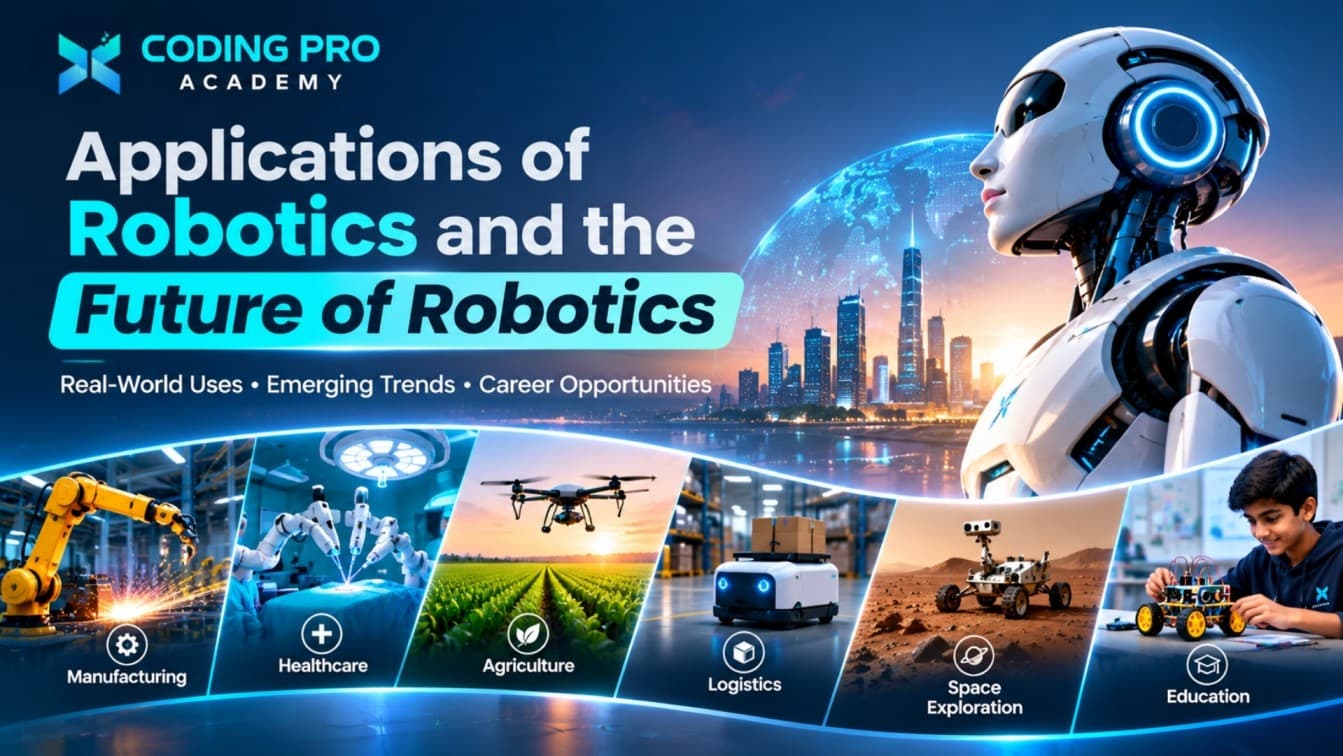
Applications and Future of Robotics | Best Robotics Classes in Pal
Where robots are used today, from car plants to the Moon, what the future of robotics looks like, and how to choose the best robotics classes in Pal, Surat.
November 3, 2026
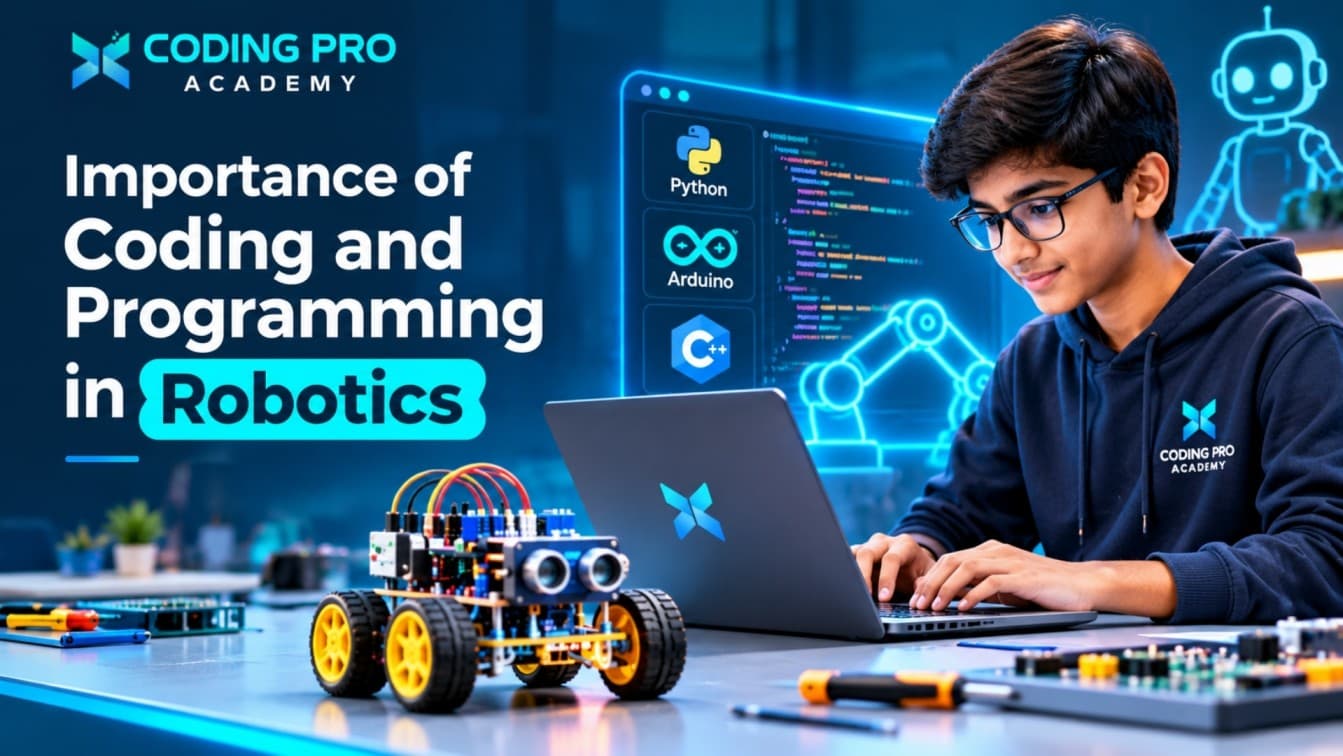
Importance of Coding in Robotics | Best Robotics Classes in Adajan
Why code is the real brain of every robot — how programs control sensors and motors, which languages students should learn, and why the best robotics classes in Adajan, Surat teach coding first.
