Applications and Future of Robotics | Best Robotics Classes in Pal
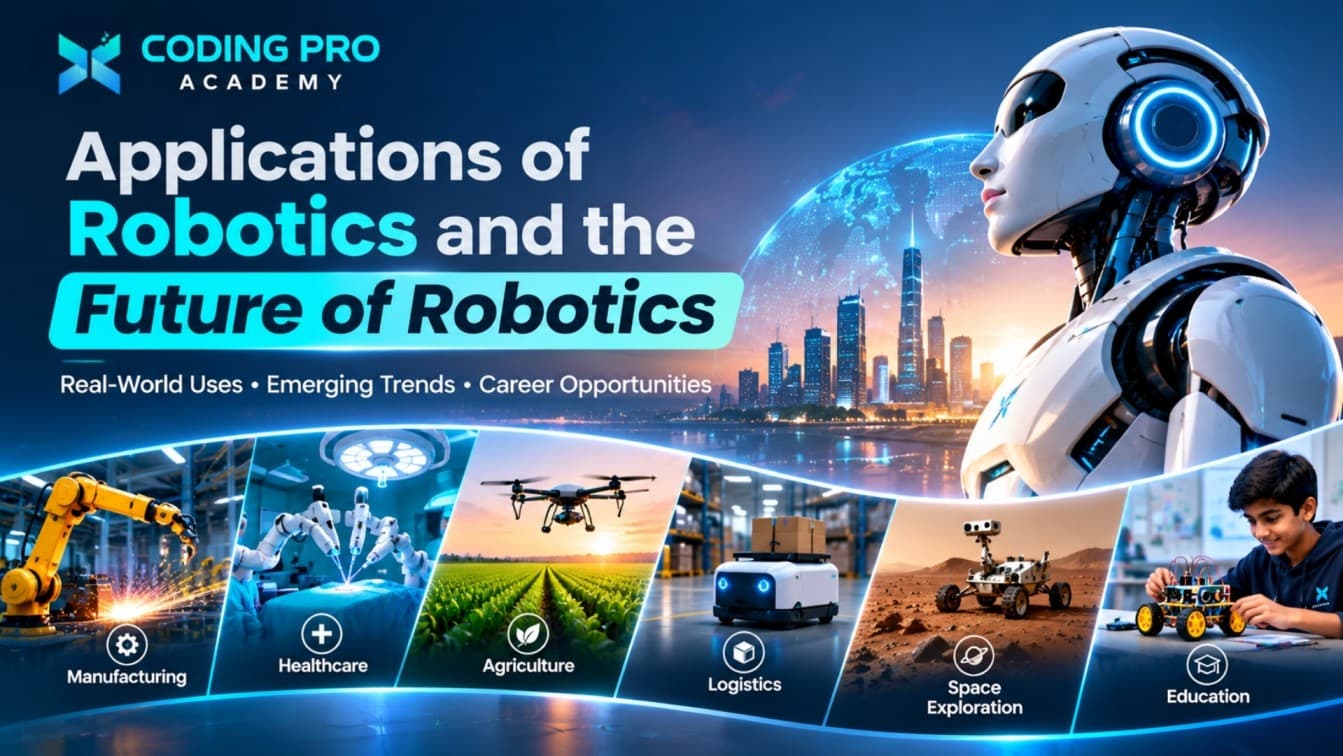
Applications and Future of Robotics: Learn at the Best Robotics Classes in Pal, Surat
The next time you order something online, there is a fair chance a robot helped move it through a warehouse. If you visit a modern car showroom, the car was very likely welded by robotic arms. And in 2023, an Indian robot rolled across the surface of the Moon. Robots are no longer a distant idea; they are already part of how things get made, moved and discovered. This guide walks through the main applications of robotics, the trends shaping the future of robotics, and how students can start learning at the best robotics classes in Pal, Surat.
If you would like a quick introduction first, read our guide on what is robotics.
What Are the Applications of Robotics?
The applications of robotics are all the places where machines take over work that is too repetitive, too precise, too heavy or too risky to leave entirely to people. In most cases, robots do not replace human workers completely. They take over the tiring or dangerous part of a job, while people plan, supervise and repair.
Here is a quick overview before we look at each area in more detail:
| Area | What robots do there | Example you may know |
|---|---|---|
| Manufacturing | Weld, paint, assemble and inspect | Robotic arms in car plants |
| Healthcare | Support surgeons and help patients recover | Robot-assisted surgery systems |
| Agriculture | Survey crops, spray and water fields | Farm drones |
| Warehouses and delivery | Move, sort and pick parcels | Mobile robots in e-commerce warehouses |
| Space | Explore the Moon and planets | ISRO's Pragyan rover, NASA's Perseverance rover |
| Homes | Clean floors and automate devices | Robotic vacuum cleaners |
| Education | Teach coding, electronics and design | Student-built line-following robots |
Robots in Factories and Manufacturing
Factories were the first big home for robots, and they are still the largest. Robotic arms are well suited to jobs where the same movement must be repeated with almost no variation: welding seams on a car body, spraying an even coat of paint, placing tiny components on a circuit board, or checking finished products with a camera for defects.
Car plants in Gujarat and across India use these arms on their assembly lines. People are still essential in these factories — someone has to program the robots, keep them running and decide what the line should produce next. In fact, automation has created a steady demand for technicians and engineers who understand both machines and code.
Robots in Hospitals and Healthcare
In medicine, robots are mainly helpers. In robot-assisted surgery, a surgeon sits at a console and controls slim robotic instruments, which can make very small, steady movements in certain procedures. Rehabilitation robots guide a patient's arm or leg through repeated exercises after some injuries. Larger hospitals also use small delivery robots to carry medicines and samples between floors.
The decisions still belong to doctors and nurses. The robot's role is to make their work more precise or to take over routine trips around the building.
Robots in Farming
Agriculture is one of the newer but fastest-moving areas. Drones can fly over fields and capture images that show which patches of crop are stressed. Some machines can tell weeds from crops and remove them. Automated irrigation systems use soil-moisture sensors to decide when to switch the water pump on.
That last example is worth noticing, because it is the same logic students write in class: read a sensor, compare the value with a limit, and switch something on or off.
Robots in Warehouses and Delivery
Large online retailers rely heavily on robotics behind the scenes. Instead of staff walking long aisles to find each item, mobile robots carry entire shelves to packing stations. Automated guided vehicles follow marked paths across the floor, and sorting machines route parcels to the right delivery zone.
Delivery drones and small self-driving delivery robots are also being tested in several countries, including India. These rely on sensors, maps and AI to find their way safely.
Robots in Space Exploration
Space is where robots go first because the journey is long, the conditions are harsh and the cost of sending people is enormous. NASA's Perseverance rover has been studying rocks on Mars since 2021. Closer to home, ISRO's Pragyan rover explored the Moon's south polar region during the Chandrayaan-3 mission in 2023, sending back measurements of the lunar surface.
For students, these missions are a powerful reminder that the sensors, motors and code they use on a classroom kit are the same building blocks used by space agencies — just engineered to a much higher standard.
Robots in Everyday Life
Robotic vacuum cleaners are now common in Indian homes. They use sensors to detect walls, furniture and stairs, then change direction — exactly like a student's obstacle-avoiding car. Automatic lawn mowers, pool cleaners and smart home systems that control lights and locks are other everyday examples of robotics at work.
Robots in Education
Classrooms are one of the most important applications of all, because they prepare the people who will build tomorrow's robots. Educational robotics is a central part of STEM education in Surat, letting students turn science and maths lessons into machines that actually move.
We have written a separate guide on the importance of coding in robotics, which explains the robotics projects for students that teach the most useful programming skills.
What Is the Future of Robotics?
The future of robotics is being shaped by better sensors, cheaper hardware and rapid progress in artificial intelligence. A few trends stand out:
- Robots that learn — AI is helping robots handle objects and situations they were not specifically programmed for.
- Robots that work beside people — collaborative robots, or cobots, are light and safe enough to share a workbench with human staff, which makes automation possible for smaller workshops.
- Smarter healthcare support — robots are expected to play a growing role in surgery assistance, rehabilitation and elderly care.
- More autonomous machines — delivery drones, warehouse robots and driver-assistance systems are steadily improving.
- Helpers at home — household robots may move beyond cleaning into security and assistance for older family members.
How quickly these changes arrive will depend on cost, safety rules and reliability. What is already clear is that people who understand robotics, coding and AI will have a big advantage.
Careers in Robotics
The growth of robotics is creating a range of career paths. Some of the most common are:
| Career | What the work involves |
|---|---|
| Robotics engineer | Designing, building and testing robots |
| Automation engineer | Setting up automated machines in factories and plants |
| Embedded systems developer | Writing code that runs directly on microcontrollers |
| Robotics software developer | Building the programs that control robots and connect them to AI |
| Computer vision engineer | Helping machines understand images and video |
| Research and development | Inventing and improving new robotic technologies |
Why Students Should Start Learning Robotics Now
Robotics for school students is not about choosing a career at the age of ten. It is about building habits that help in any field: thinking step by step, testing ideas, learning from failure and working as a team. A well-planned robotics course for kids starts with simple circuits and block coding, so even complete beginners feel confident from the first class.
Because every robot depends on code, students who want to go further can also strengthen their programming through our best coding classes in Surat.
How to Learn Robotics for Beginners
If you want to learn robotics for beginners, the order you learn things in matters more than the kit you buy. A sensible path looks like this:
- Understand the idea — a robot senses, decides and acts.
- Learn the parts — sensors, motors, controller boards and simple circuits.
- Start coding — block coding first, then Arduino, then Python.
- Build small projects — a line follower, an obstacle-avoiding car or a smart dustbin.
- Explore further — automation, computer vision and beginner AI.
Good robotics training for students follows this same order, with a trainer on hand to explain what went wrong when a project does not work the first time.
How to Choose the Best Robotics Classes in Pal
When you search for robotics classes near me, it helps to have a short checklist ready:
- Does every student build with real sensors, motors and boards?
- Is coding part of every project, not just an optional extra?
- Are the levels matched to your child's age and experience?
- Does the course connect lessons to real applications, like the ones in this article?
- Can you see examples of what current students have built?
Best Robotics Classes in Pal, Surat at Coding Pro Academy
Coding Pro Academy is a robotics learning academy where students learn by building working models and writing the code that drives them. Our robotics course in Surat links every project to a real-world application — from factory automation to space rovers — so students understand why what they are learning matters.
We offer robotics training in Surat at our Pal centre for students looking for the best robotics classes in Pal, and families nearby can also choose our robotics classes in Adajan. Visit us to see student projects in action and ask about current batch timings.
Conclusion
Robots are already welding cars, helping surgeons, watching over crops, moving parcels and exploring the Moon. Over the coming years they will become smarter, safer and more common in daily life. The students who understand how these machines work will be the ones designing and improving them. A simple first project is the best place to begin, and the best robotics classes in Pal, Surat can give your child that start with the right guidance.
Related posts

November 4, 2026
AI and Machine Learning Internship in Surat (2026 Guide)
AI internship in Surat for students and freshers: skills you will learn, real AI projects, who can apply, career paths and how to choose a program in Adajan.
November 3, 2026
Importance of Coding in Robotics | Best Robotics Classes in Adajan
Why code is the real brain of every robot — how programs control sensors and motors, which languages students should learn, and why the best robotics classes in Adajan, Surat teach coding first.
