Importance of Coding in Robotics | Best Robotics Classes in Adajan
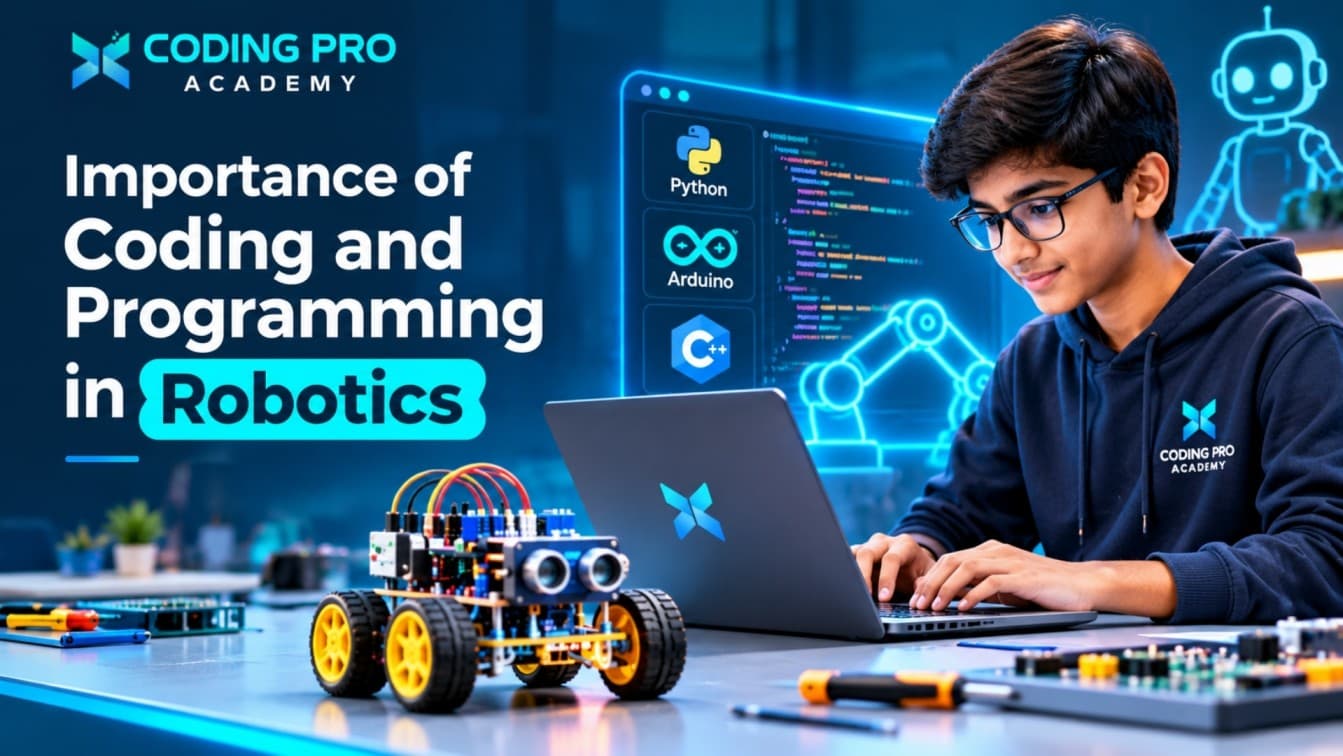
Importance of Coding in Robotics: Why the Best Robotics Classes in Adajan Teach Code First
Hand a student a box of motors, wheels, wires and a sensor, and they can build something that looks like a robot within an hour. But switch it on and nothing happens. The parts are all there, yet the machine has no idea what to do. That missing piece is code. In this guide we look at the importance of coding in robotics, how a program actually controls a machine, which languages make sense at each age, and what parents should expect from the best robotics classes in Adajan, Surat.
If you are completely new to the subject, you may want to begin with our guide on what is robotics and then come back here.
What Does Programming Mean in Robotics?
In robotics, programming is the job of writing down every decision the machine will need to make. The hardware gives the robot its abilities — it can measure distance, spin a wheel or turn on a light. The program decides when each of those abilities is used and in what order.
Think of the hardware as a cricket team and the program as the captain. Eleven skilled players still need someone to decide who bowls, where the fielders stand and when to change the plan. Without that captain, talent alone does not win the match.
Why Is Coding So Important in Robotics?
Every useful thing a robot does can be traced back to a line of code. Here are the main jobs a program handles:
- Movement — deciding how fast each motor turns, for how long, and in which direction.
- Reacting to surroundings — turning sensor numbers into actions, such as stopping when something is too close.
- Repeating work reliably — a factory robot can place the same part in the same spot thousands of times because the instructions never change.
- Safety — programs can include limits, like cutting power if a motor gets stuck.
- Intelligence — code is what connects a robot to cameras, AI models and machine learning.
Change the code and the same robot can do a completely different job. That flexibility is the real reason robotics and programming are taught together.
How Does Code Control a Robot? A Line-Follower Example
The line-following robot is a favourite first project because it shows the whole idea in a few minutes. The robot sits on a white sheet with a thick black line drawn on it. Two infrared sensors face the floor, one on the left and one on the right. White paper reflects a lot of infrared light and black tape reflects very little, so each sensor can tell whether it is above the line.
The program checks both sensors over and over, very quickly:
- If neither sensor sees black, the line is between them, so the robot drives straight.
- If the left sensor sees black, the robot has drifted to the right, so it steers left.
- If the right sensor sees black, the robot has drifted to the left, so it steers right.
Written in simple code-style steps, it looks like this:
repeat forever:
    left  = read left sensor
    right = read right sensor
    if left sees black:
        steer left
    else if right sees black:
        steer right
    else:
        go straight
Those few lines already use three of the most important ideas in all of programming: variables to store readings, conditions to choose between actions, and a loop to keep checking. Students who understand this example have taken their first real step into coding.
Which Programming Languages Are Used in Robotics?
There is no single best language. The right choice depends on the student's age and on what the robot needs to do.
| Language or tool | Where it fits | Suitable for |
|---|---|---|
| Scratch / Blockly | Learning logic by snapping blocks together | Young beginners |
| Arduino (based on C/C++) | Reading sensors and driving motors on real hardware | Beginners to intermediate |
| Python | Automation, camera-based projects and AI | Older students and above |
| C and C++ | Fast, low-level control inside embedded systems | Intermediate to advanced |
Block coding removes the fear of typing mistakes, so younger children can focus on logic. Arduino is usually the bridge to real code, because students type instructions and immediately see an LED blink or a motor spin. Python comes next for those who want to explore cameras, data and artificial intelligence, while C and C++ are the tools engineers use when speed and precise hardware control matter most.
Students who want to build a stronger base in these languages can also join our best coding classes in Surat or programming classes in Surat.
How Programs Make Sense of Sensors
A sensor only produces a number. It is the program that gives that number meaning. Here are the sensors students meet most often and the kind of rule a program might use with each:
| Sensor | What it reads | Example rule in the program |
|---|---|---|
| Ultrasonic | Distance, using sound echoes | If something is closer than 20 cm, stop and turn |
| Infrared (IR) | How much infrared light bounces back | If the floor looks dark, steer towards the line |
| Light sensor (LDR) | Brightness of the room | If it is dark, switch the lamp on |
| Temperature | Heat level | If it gets too warm, start the fan |
| Push button / touch | Whether it is pressed | If pressed, start or stop the robot |
Robotics Projects for Students and the Coding Skill Each One Teaches
A good course does not pick projects at random. Each build should introduce one new programming idea, so students grow step by step. This is how we think about the usual beginner projects:
- Traffic-light LEDs — teaches sequence and timing, because the lights must change in the right order.
- Obstacle-avoiding car — teaches if-else decisions based on a distance reading.
- Line-following robot — teaches loops that check sensors many times a second.
- Smart dustbin — teaches how one input (a hand nearby) controls one output (a servo motor).
- Bluetooth car — teaches how a robot receives commands from a phone.
- Mini home-automation model — teaches functions, so a bigger program stays neat and organised.
This is the most practical way to learn robotics for beginners: by the time a student finishes these robotics projects for students, they have quietly learned most of the basics of programming.
How Robotics Makes Students Better Programmers
On a screen, a bug is just an error message. On a robot, a bug is a car spinning in circles on the classroom floor. That instant, visible feedback makes students far more curious about what went wrong — and far more satisfied when they fix it.
- They learn to break a big goal into small, ordered steps.
- They learn debugging by checking the code, the wiring and the sensor values one by one.
- They use variables, loops, conditions and functions for a real purpose, not just for an exam.
- They start designing their own features instead of only copying examples.
These habits transfer straight into Python, web development, app development and AI later on.
Where Coding, Robotics and AI Meet
A traditional program follows fixed rules written by a person. Artificial intelligence adds models that learn patterns from examples, such as thousands of photos of fruit. When the two come together, a robot can do things that would be almost impossible to write as simple rules — like telling a ripe mango from an unripe one using a camera.
Even then, a programmer still writes the code that connects the camera, the AI model and the motors. That is why strong coding skills remain the foundation, no matter how advanced the robot becomes.
Why School Students Should Learn Coding Through Robotics
Robotics for school students turns coding from an abstract screen activity into something they can hold, test and show their family. It is one of the most hands-on parts of STEM education in Surat, linking science, technology, engineering and maths in a single project.
A well-structured robotics course for kids follows a clear order — block coding first, then Arduino, then Python or C++ — so children never feel lost. Good robotics training for students also gives them a portfolio of working models, which builds confidence and helps later in school competitions and science fairs.
How to Choose the Best Robotics Classes in Adajan
When you search for robotics classes near me, look past the advertisements and ask these questions:
- Will my child write the code for every robot, or only assemble kits?
- Does the course move from block coding to typed code at a sensible pace?
- Does every student get their own hands-on time with the hardware?
- Is there a finished, working project at the end of each module?
- Does the trainer help students find their own mistakes instead of fixing everything for them?
Best Robotics Classes in Adajan, Surat at Coding Pro Academy
At Coding Pro Academy, coding is not an extra topic added to robotics — it is the centre of every lesson. As a robotics learning academy, we take students from block-based logic to Arduino programming and beyond, with a working project at each stage. Our robotics course in Surat is designed so that students understand not only how to build a robot but why it behaves the way it does.
We offer robotics training in Surat at our Adajan centre, and families living closer to Pal can join our robotics classes in Pal. Visit the centre, see what current students are building, and ask about batch timings that suit your child.
Conclusion
Motors give a robot strength and sensors give it awareness, but code gives it purpose. Learning to program a robot teaches children logic, patience and problem-solving in a way that feels like play. If you want your child to build that foundation properly, choose the best robotics classes in Adajan — ones where every student writes real code and watches it come to life.
Continue learning
Want to go further? Explore our Python course.
Related posts
November 4, 2026
AI and Machine Learning Internship in Surat (2026 Guide)
AI internship in Surat for students and freshers: skills you will learn, real AI projects, who can apply, career paths and how to choose a program in Adajan.

November 4, 2026
Data Science Internship in Surat (2026 Guide)
Data science internship in Surat for students and freshers: Python, SQL, Excel, Power BI, real data projects, careers and choosing a course in Adajan.
