Database Management System (DBMS) & SQL Course in Adajan, Surat | Learn Database Design, SQL & Query Optimization
Master Database Management Systems, SQL, Database Design & Query Optimization Through Practical Training
Looking for the best DBMS Course in Adajan or searching for SQL Classes in Adajan, Surat? Want to learn how modern applications store, manage, retrieve, and secure data efficiently? This Database Management System (DBMS) & SQL Course is designed for students, software developers, aspiring database administrators, engineering students, and IT professionals who want to build strong database management skills through practical learning, SQL programming, and real-world database design.
Whether you're searching for a DBMS Course in Adajan, SQL Training in Surat, Database Management System Classes, MySQL Course, Database Design Course, SQL Certification Training, or a Database Administration Course, this structured program provides a complete roadmap from database fundamentals to SQL programming, normalization, transaction management, query optimization, indexing, and database architecture.
Databases are the backbone of almost every modern software application. From banking systems, e-commerce platforms, hospital management software, mobile applications, social media platforms, and enterprise business applications to cloud-based services, every organization depends on databases to securely store, organize, manage, and retrieve information efficiently.
As organizations generate increasing volumes of data, professionals with strong database management skills are in high demand across software development, web development, mobile app development, cloud computing, business intelligence, Artificial Intelligence, Data Science, and enterprise IT. Understanding DBMS concepts is also essential for technical interviews, competitive examinations, and software engineering careers.
Unlike courses that focus only on theoretical database concepts, this DBMS & SQL Course emphasizes practical implementation from the beginning. Students learn database design, SQL programming, normalization, transaction processing, query optimization, indexing, database security, and relational database concepts through live demonstrations, practical exercises, SQL queries, and industry-oriented examples.
The curriculum introduces students to transaction processing, ACID properties, concurrency control, database security, database architecture, ER modeling, relational database design, normalization, relational algebra, SQL programming, query processing, indexing techniques, hashing methods, storage management, and query optimization. Every module combines conceptual understanding with practical SQL implementation to strengthen both theoretical and technical knowledge.
Throughout the course, learners develop strong analytical thinking, logical problem-solving abilities, SQL programming skills, database design expertise, and query optimization techniques while working with practical examples and relational database systems. Every concept prepares students for real-world database development and modern software engineering environments.
Whether your goal is to become a SQL Developer, Database Administrator (DBA), Backend Developer, Software Engineer, Data Analyst, Database Engineer, Business Intelligence Developer, or continue toward advanced Data Science and Cloud Database technologies, this Database Management System (DBMS) & SQL Course in Adajan, Surat provides the technical foundation, practical knowledge, and industry-focused skills needed to build a successful career in database technologies.
What is Database Management System (DBMS)?
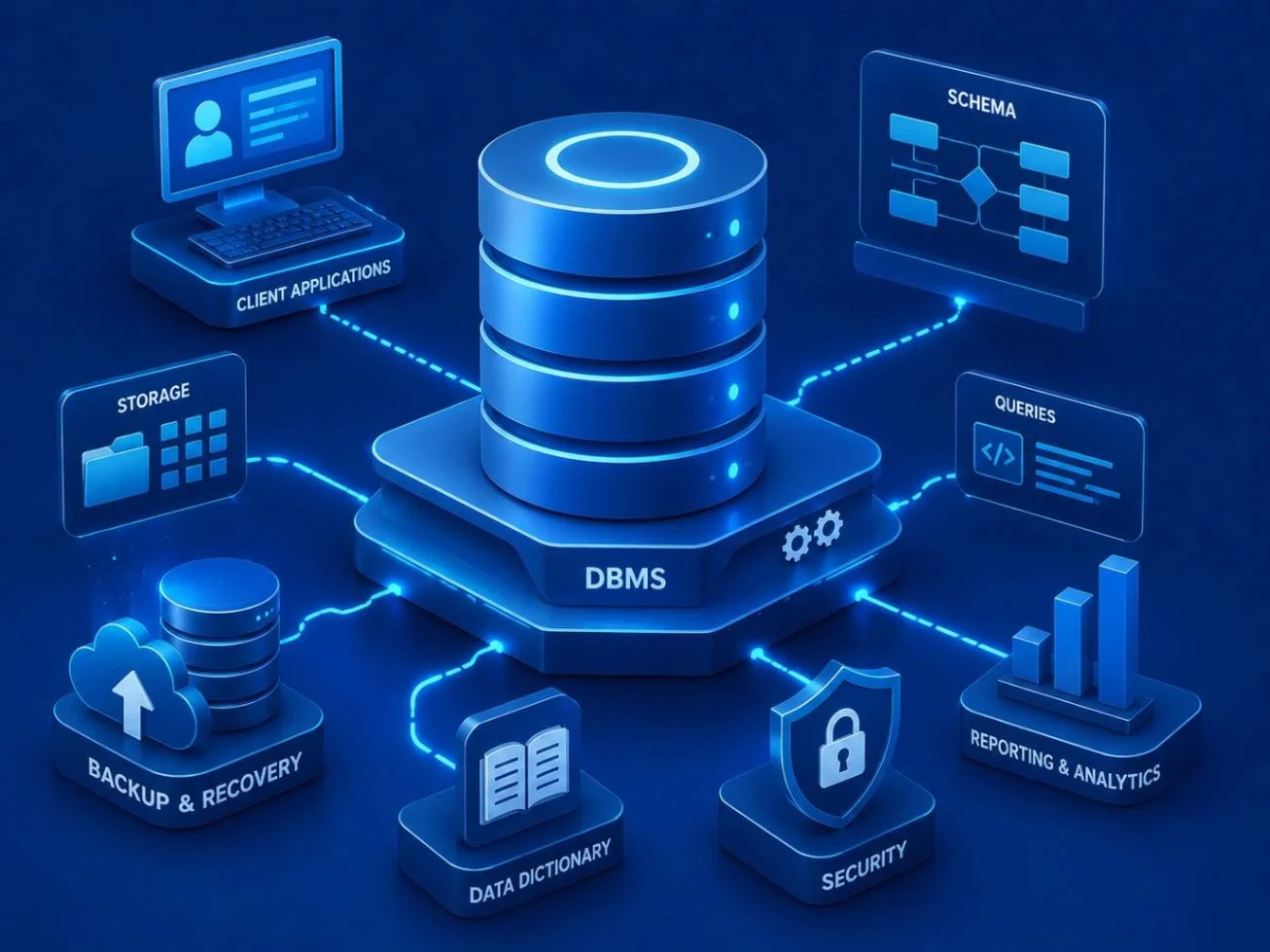
A Database Management System (DBMS) is software that enables users and applications to create, store, organize, retrieve, update, secure, and manage structured data efficiently. Rather than storing information in separate files, DBMS organizes data into structured databases that allow fast access, better consistency, improved security, and reliable transaction processing.
Modern Database Management Systems support multiple users, maintain data integrity, provide backup and recovery mechanisms, enforce security policies, and ensure efficient storage management. Popular database technologies include MySQL, PostgreSQL, Oracle Database, Microsoft SQL Server, MongoDB, and cloud-based database services.
SQL (Structured Query Language) is the standard language used to communicate with relational databases. It allows developers and database administrators to create databases, define tables, insert records, update information, retrieve data, perform joins, manage transactions, and optimize database performance.
Together, Database Management Systems, SQL programming, relational database design, normalization, indexing, and query optimization form the foundation of modern software applications, enterprise systems, cloud platforms, and business information management.
Why Learn Database Management System (DBMS) & SQL?
Database Management Systems (DBMS) form the backbone of almost every modern software application. Whether you're using a banking app, shopping online, booking a hotel, watching videos, or managing business operations, every application depends on a well-designed database to store, retrieve, and process information efficiently. Learning DBMS helps you understand how data is organized, managed, secured, and accessed in real-world software systems.
SQL (Structured Query Language) is one of the most valuable technical skills in the software industry because it enables developers, database administrators, analysts, and engineers to communicate with relational databases. From retrieving customer records to managing millions of transactions, SQL is used every day by organizations across every industry.
One of the greatest advantages of learning DBMS is its universal application. Whether you want to become a Software Developer, Full Stack Developer, Backend Developer, Data Scientist, Data Analyst, AI Engineer, Cloud Engineer, or Database Administrator, database knowledge is an essential part of your technical foundation.
Another major benefit is problem-solving ability. DBMS teaches students how to design efficient databases, maintain data integrity, optimize queries, improve application performance, secure sensitive information, and handle large volumes of business data. These practical skills are highly valued in today's software industry.
As cloud computing, Artificial Intelligence, Big Data, and enterprise applications continue evolving, databases remain one of the most important technologies powering modern digital systems. Strong DBMS and SQL knowledge creates long-term career opportunities across multiple technical domains.
Where is DBMS Used?
Database Management Systems are used in almost every industry because nearly every organization stores and manages digital information. From small businesses to multinational corporations, databases support daily operations, customer management, financial transactions, reporting, and business intelligence.
Banking & Financial Services
Banks use databases to manage customer accounts, online transactions, payment processing, ATM operations, loan management, and fraud detection while maintaining high levels of security and reliability.
Healthcare
Hospitals and healthcare organizations use databases to manage patient records, appointments, prescriptions, medical history, laboratory reports, billing systems, and healthcare analytics.
E-Commerce & Retail
Online shopping platforms use databases to manage products, inventory, customer accounts, orders, payments, shipping information, and personalized recommendations.
Education
Schools, colleges, universities, and online learning platforms use databases to manage admissions, student records, attendance, examinations, learning management systems, and academic reporting.
Government Organizations
Government departments rely on databases for citizen information, taxation, public records, digital services, election systems, transportation management, and administrative operations.
Software & IT Companies
Software development companies build applications that rely on databases to store user information, application settings, transactions, logs, analytics, and business data.
Manufacturing & Logistics
Manufacturing companies use databases to manage production planning, inventory, warehouse operations, supply chains, vendor management, and logistics tracking.
Telecommunications & Cloud Platforms
Telecommunication providers and cloud service companies use databases to manage customer subscriptions, network information, billing, authentication, service monitoring, and large-scale data storage.
Because data powers every modern business, DBMS professionals remain essential across virtually every technology sector.
Why Organizations Invest in Database Management Systems
Organizations invest heavily in Database Management Systems because data is one of their most valuable business assets. A well-designed database improves application performance, protects sensitive information, supports business decision-making, and ensures reliable data availability.
Modern DBMS solutions allow organizations to manage millions of records efficiently while maintaining security, consistency, scalability, and reliability. Features such as transaction management, backup and recovery, indexing, concurrency control, access management, and query optimization help organizations deliver high-performance software systems.
Database Management Systems also reduce redundancy, improve data consistency, simplify application development, and enable businesses to make faster, data-driven decisions. Whether managing customer information, financial transactions, healthcare records, or enterprise applications, reliable database systems remain critical to business success.
As businesses continue generating increasing volumes of digital information, professionals with practical DBMS and SQL expertise remain in high demand worldwide.
Why Choose Our DBMS & SQL Course?
Learning Database Management Systems requires much more than memorizing SQL commands. Professional database developers and administrators must understand database architecture, relational design, normalization, transaction management, query optimization, indexing techniques, and database security. Our course is designed to develop these practical skills through structured learning and real-world implementation.
Every module begins with clear conceptual explanations followed by practical SQL demonstrations and database exercises. Students immediately apply their knowledge by designing relational databases, writing SQL queries, managing transactions, creating relationships, optimizing queries, and working with realistic business scenarios.
Rather than teaching SQL syntax alone, students understand how complete database systems are designed, implemented, optimized, secured, and maintained in professional software environments.
At Coding Pro Academy, practical implementation remains the primary focus. Students strengthen their SQL programming skills while learning database architecture, ER modeling, normalization, indexing, storage management, query optimization, and relational database concepts through hands-on exercises and guided mentoring.
What Makes This DBMS & SQL Course Different?
✔ Beginner-friendly learning roadmap
✔ Database Management System Fundamentals
✔ SQL Programming (DDL, DML, DCL & TCL)
✔ Relational Database Design
✔ Entity Relationship (ER) Modeling
✔ Database Normalization
✔ Transaction Processing & ACID Properties
✔ Database Security Concepts
✔ Query Processing & Optimization
✔ Indexing & Hashing Techniques
✔ Practical SQL Query Sessions
✔ Industry-Oriented Database Projects
✔ Individual Doubt-Solving Sessions
✔ Course Completion Certificate
✔ Career Guidance & Placement Assistance
By the end of the course, students will confidently design relational databases, write professional SQL queries, optimize database performance, understand transaction management, implement database security concepts, and build a strong foundation for careers in Software Development, Database Administration, Data Analytics, Backend Development, and Cloud Database technologies.
How We Teach Database Management System (DBMS) & SQL
Learning Database Management Systems is much more than memorizing SQL commands or database definitions. It is about understanding how modern software applications store, organize, retrieve, secure, and manage information efficiently. Our teaching methodology focuses on practical implementation, enabling students to build strong database design skills while working with real-world business scenarios and relational databases.
Every module begins with a strong conceptual foundation before moving into practical SQL demonstrations and hands-on exercises. Students first understand why a database concept is important before implementing it through relational database design, SQL programming, normalization techniques, and query optimization. Every topic is reinforced through assignments, practical exercises, case studies, and database projects to ensure complete understanding.
Rather than teaching SQL syntax, normalization, ER diagrams, transaction processing, and database security as separate topics, the course demonstrates how these concepts work together to build efficient, secure, and scalable database systems. Students learn how to design databases, create relationships between tables, write optimized SQL queries, manage transactions, implement security controls, and improve database performance using industry-standard practices.
Throughout the course, learners also understand professional database development workflows including requirement analysis, database planning, ER modeling, schema design, normalization, indexing, query optimization, transaction management, and storage management. Continuous practical implementation strengthens logical thinking, analytical reasoning, database modeling, and SQL programming skills while preparing students for professional software development environments.
Our objective is to ensure that every student completes the course with practical database knowledge, confidence in SQL programming, and the technical foundation required for careers in Software Development, Backend Development, Database Administration, Data Analytics, and Cloud Database technologies.
Our Learning Roadmap
The Database Management System & SQL Course follows a structured roadmap that gradually transforms beginners into confident database professionals. Every stage introduces new concepts while strengthening practical implementation through SQL programming, database design exercises, and industry-oriented examples.
Step 1 – Build Strong Database Fundamentals
Students begin by understanding databases, transaction processing, ACID properties, transaction states, concurrency control, database security, and the role of Database Management Systems in modern software applications. This stage establishes the conceptual foundation required before designing relational databases.
Step 2 – Learn Database Architecture & Data Modeling
Students study database system architecture, three-level architecture, data independence, Entity Relationship (ER) modeling, ER diagrams, relational models, hierarchical models, and network database concepts. Practical exercises help students understand how real-world databases are designed before implementation.
Step 3 – Master SQL Programming & Relational Database Design
Students learn SQL fundamentals including DDL, DML, DCL, and TCL commands while understanding relational algebra, relational calculus, database schema design, primary keys, foreign keys, constraints, and normalization techniques. Practical SQL exercises help students confidently interact with relational databases.
Step 4 – Optimize Database Performance
Students explore query processing, query optimization, indexing methods, hashing techniques, storage management, and file organization strategies. They understand how professional database systems maintain high performance while managing large volumes of information efficiently.
Step 5 – Build Practical Database Projects
The final stage focuses on applying everything learned throughout the course. Students design complete relational databases, implement SQL operations, optimize queries, manage transactions, and solve practical business database problems using industry-standard database design methodologies.
Every stage includes practical SQL exercises, database design activities, normalization problems, case studies, quizzes, and project-based learning to ensure students gain practical DBMS skills rather than only theoretical knowledge.
Who Can Join This DBMS & SQL Course?
This course is designed for anyone who wants to build a strong understanding of Database Management Systems and SQL. Whether you are a beginner learning database concepts for the first time, a college student preparing for placements, a software developer strengthening backend skills, or a working professional upgrading your technical knowledge, this course provides a structured learning path suitable for learners from different backgrounds.
The curriculum begins with database fundamentals before gradually progressing toward database architecture, ER modeling, SQL programming, normalization, transaction processing, indexing, query optimization, storage management, and practical database development. Every concept is explained using business-oriented examples, relational database exercises, and live SQL demonstrations that make database concepts easier to understand.
This Course is Ideal For
✔ School & College Students
✔ Diploma, BCA, MCA, B.Sc. & Engineering Students
✔ SQL Beginners
✔ Aspiring Database Administrators (DBA)
✔ Software Developers
✔ Backend Developers
✔ Web Developers
✔ Data Analysts
✔ Database Enthusiasts
✔ Anyone Preparing for Technical Interviews
No previous database experience is required. Basic computer knowledge is sufficient to begin learning Database Management Systems and SQL.
What You'll Learn
The Database Management System & SQL Course follows a practical curriculum that introduces students to the complete database ecosystem while strengthening SQL programming, logical reasoning, analytical thinking, and database design skills.
Students begin with transaction processing, database security, database architecture, ER modeling, relational models, relational algebra, database normalization, schema design, SQL programming, query optimization, indexing, hashing techniques, storage management, and complete relational database implementation.
Rather than studying isolated database concepts, students understand how modern database systems are designed, optimized, secured, and managed within professional software environments. Through continuous SQL practice, database design exercises, normalization problems, assignments, quizzes, and practical projects, learners develop the confidence required to build reliable relational database systems.
Every module strengthens logical thinking, database architecture knowledge, SQL programming ability, query optimization techniques, and software development skills while preparing students for careers in Database Administration, Backend Development, Software Engineering, Data Analytics, and Cloud Database technologies.
Skills You'll Develop
Modern software professionals require a combination of database knowledge, SQL programming skills, analytical thinking, and database optimization techniques. This course develops the practical skills required to design, manage, secure, and optimize relational database systems.
After Completing This Course, You'll Be Able To
✔ Understand Database Management System architecture
✔ Design professional relational databases
✔ Create ER diagrams and database schemas
✔ Write advanced SQL queries confidently
✔ Apply database normalization techniques
✔ Understand transaction processing and ACID properties
✔ Optimize SQL queries for better performance
✔ Implement indexing and hashing techniques
✔ Apply database security concepts
✔ Design scalable relational database systems
✔ Solve real-world database problems
✔ Build a strong foundation for Backend Development, Software Engineering, Data Science, Cloud Computing, and Database Administration
These practical skills prepare students for internships, SQL Developer roles, Database Administrator positions, Backend Developer careers, Software Engineering jobs, Data Analytics roles, and advanced database technologies used across modern software industries.
Learn Through Real-World Database Projects
Database Management Systems are best learned through practical implementation. While understanding database concepts is essential, true expertise comes from designing databases, writing SQL queries, managing transactions, optimizing performance, and solving real-world business problems. That is why project-based learning is one of the strongest features of our DBMS & SQL Course.
Throughout the training, students work on practical SQL exercises, database design assignments, normalization problems, relational modeling tasks, and industry-oriented database projects. Every project is carefully designed to simulate real software development environments while strengthening logical thinking, database design skills, and SQL programming ability.
Students gradually progress from understanding business requirements to designing relational databases, creating Entity Relationship (ER) diagrams, implementing schemas, writing SQL queries, optimizing database performance, and managing transactions. During the learning process, they gain practical experience applying normalization techniques, indexing methods, query optimization strategies, and database security principles that are widely used in professional software systems.
The course also introduces database optimization techniques that help students understand how modern applications efficiently manage millions of records while maintaining speed, consistency, reliability, and security. Students learn how database professionals improve application performance through proper schema design, indexing, query optimization, and storage management.
By the end of the course, students complete multiple real-world database projects that strengthen their professional portfolio and demonstrate practical expertise in SQL programming, relational database design, and database management.
Benefits of Project-Based Learning
✔ Design complete relational database systems
✔ Write professional SQL queries
✔ Build Entity Relationship (ER) diagrams
✔ Apply normalization techniques
✔ Optimize SQL queries for better performance
✔ Strengthen logical database design skills
✔ Prepare for technical interviews and software development careers
Career Opportunities After Learning DBMS & SQL
Database Management Systems remain one of the most fundamental technologies in the software industry. Every modern application, website, enterprise system, cloud platform, and mobile application depends on well-designed databases to store, organize, and retrieve information efficiently.
Organizations across banking, healthcare, education, finance, e-commerce, manufacturing, logistics, government, software development, and cloud computing actively recruit professionals with strong SQL and database management skills. Whether building applications, managing databases, analyzing business information, or developing cloud solutions, DBMS knowledge is essential for modern IT careers.
The knowledge gained through this course also creates excellent opportunities for specialization in Backend Development, Cloud Databases, Data Engineering, Business Intelligence, Data Analytics, Artificial Intelligence, Machine Learning, and Enterprise Software Development.
Whether you plan to work for multinational companies, startups, software firms, consulting organizations, or government institutions, DBMS and SQL provide one of the strongest technical foundations for long-term career growth.
Popular Career Opportunities
✔ SQL Developer
✔ Database Administrator (DBA)
✔ Backend Developer
✔ Software Developer
✔ Database Engineer
✔ Data Analyst
✔ Business Intelligence Developer
✔ Data Engineer
✔ Cloud Database Administrator
✔ Software Engineer
Why DBMS & SQL is a Smart Career Choice
Database Management Systems are among the few technologies used in nearly every software application regardless of programming language or platform. Every website, enterprise application, banking system, ERP solution, CRM platform, and cloud application depends on databases to manage information efficiently.
Unlike technologies that frequently change, the core principles of database design, relational modeling, SQL programming, normalization, indexing, transaction processing, and query optimization remain essential throughout modern software engineering. These concepts form the foundation for advanced technologies including Cloud Databases, Big Data, Data Warehousing, Artificial Intelligence, Machine Learning, and Business Intelligence.
Another significant advantage is versatility. Strong DBMS skills support careers in software development, backend engineering, cloud computing, DevOps, cybersecurity, data science, analytics, enterprise applications, and database administration. This broad applicability makes DBMS one of the most valuable technical subjects for long-term professional growth.
Whether your goal is software development, database administration, technical interviews, higher education, or advanced cloud technologies, mastering DBMS and SQL provides a strong competitive advantage in today's technology industry.
DBMS & SQL Course Highlights
What You'll Experience During the Training
✔ Database Management System Fundamentals
✔ Transaction Processing & ACID Properties
✔ Database Security Concepts
✔ Database System Architecture
✔ Entity Relationship (ER) Modeling
✔ Relational Database Design
✔ Relational Algebra & Relational Calculus
✔ Database Normalization
✔ SQL Programming (DDL, DML, DCL & TCL)
✔ SQL Joins, Functions & Advanced Queries
✔ Query Processing & Optimization
✔ Indexing & Hashing Techniques
✔ Storage Management Concepts
✔ Live SQL Practice Sessions
✔ Real-World Database Projects
✔ Individual Doubt Solving
✔ Course Completion Certificate
✔ Career Guidance & Placement Assistance
Why Students Choose DBMS & SQL Classes in Adajan, Surat
Students searching for a DBMS Course in Adajan, SQL Classes in Adajan, Database Management System Course in Surat, SQL Training Institute, or Database Design Course are looking for practical training that prepares them for software development careers rather than only theoretical learning.
This course follows a project-driven learning methodology where every concept is reinforced through live SQL programming, database design exercises, normalization problems, ER diagram creation, indexing practice, query optimization, and practical business case studies. Students gain confidence while designing professional databases and solving real-world data management challenges.
Whether you're preparing for software development placements, backend engineering, database administration, technical interviews, Data Science, or cloud computing careers, this course provides the practical knowledge, technical skills, and industry-oriented experience needed to succeed in today's software industry.


 Data Analytics2 months