C Programming Course in Adajan, Surat | Learn C Programming from Scratch
Build Strong Programming Fundamentals with Practical C Training, Live Coding & Real-World Problem Solving
Looking for the best C Programming Course in Adajan or searching for C Programming Classes in Adajan, Surat? Want to learn programming from the ground up through practical coding instead of only theoretical concepts? This C Programming course is designed for students, beginners, diploma learners, engineering students, and aspiring software developers who want to build a strong programming foundation and develop logical thinking skills.
Whether you're searching for a C Programming Training Institute in Adajan, C Programming Classes in Surat, C Language Course for Beginners, C Programming Coaching in Adajan, or a professional C Programming Course, this structured training program provides practical learning through live coding sessions, programming exercises, assignments, and hands-on practice that prepares students for software development and technical interviews.
C Programming is one of the most influential programming languages in computer science and software development. It forms the foundation of many modern programming languages and helps students understand how software interacts with computer memory, processors, and operating systems. Learning C not only teaches programming syntax but also develops logical thinking, analytical skills, and a deeper understanding of how programs are executed.
Every concept is taught using a practical, step-by-step learning methodology. Students write programs from the very first session, understand programming logic through examples, solve coding challenges, and gradually build confidence by developing increasingly complex programs. Instead of memorizing code, learners understand how to think like programmers and solve problems systematically.
Whether your goal is to become a Software Developer, prepare for Data Structures, strengthen your programming fundamentals, or build a strong base before learning C++, Java, Python, or other programming languages, this C Programming Course in Adajan, Surat provides the knowledge and practical experience needed to begin your software development journey with confidence.
What is C Programming?
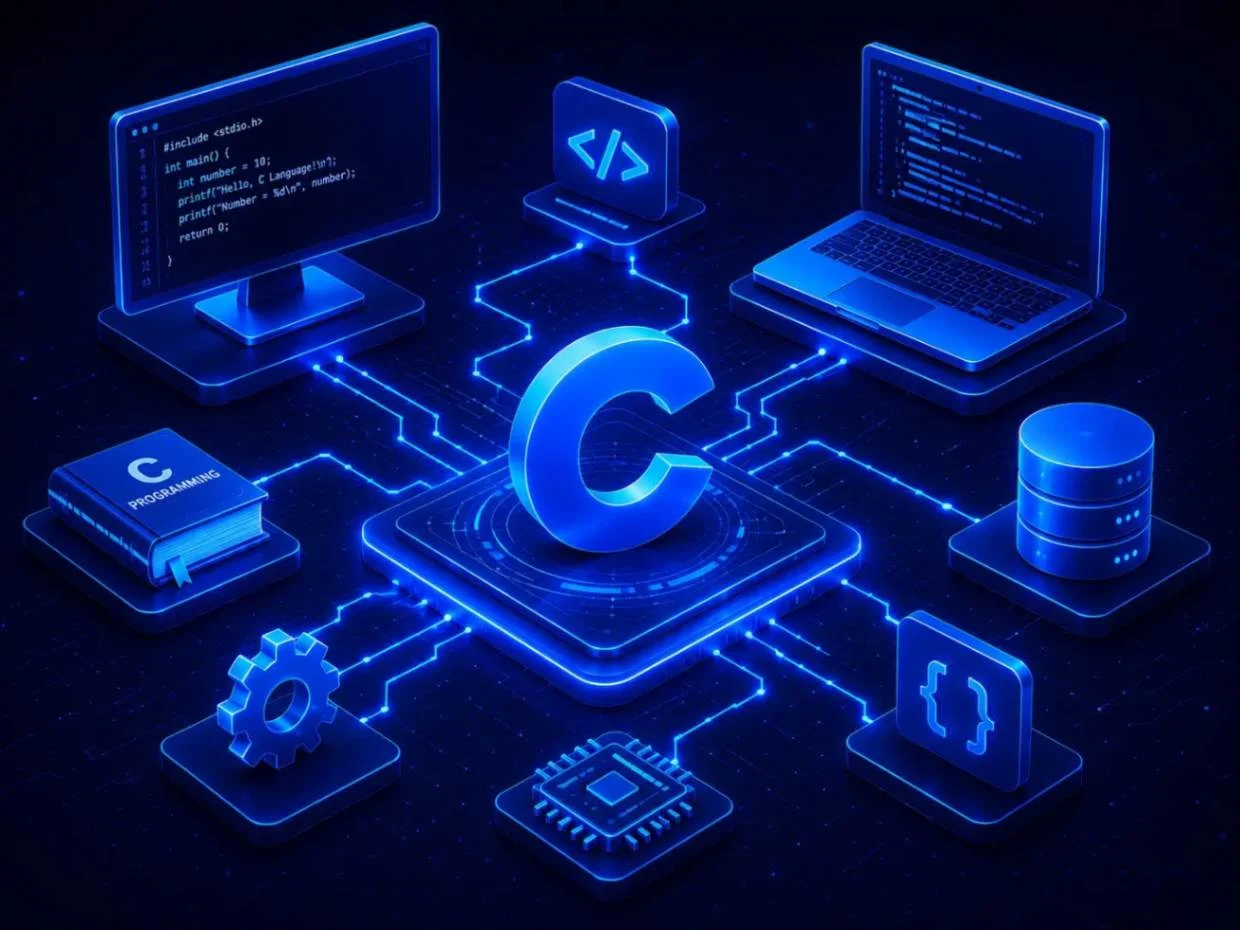
C is a general-purpose, procedural programming language that has played a significant role in the evolution of modern computing. Developed to create efficient and reliable software, C continues to be one of the most widely taught programming languages because it provides a deep understanding of programming fundamentals and computer architecture.
Unlike many modern programming languages that hide low-level operations, C allows programmers to understand memory management, variables, pointers, functions, and program execution in greater detail. This helps students develop strong programming habits while improving logical thinking and problem-solving abilities.
C is widely used in operating systems, embedded systems, device drivers, networking software, compilers, database systems, and performance-critical applications where speed and efficiency are essential. Because of its simplicity and power, it also serves as the foundation for learning advanced programming concepts and many modern programming languages.
Learning C Programming is not simply about writing code. It is about understanding how software works internally, how data is stored in memory, and how efficient programs are developed using structured programming techniques.
Why Learn C Programming?
C Programming continues to be one of the best languages for beginners because it teaches the core principles of programming without hiding important concepts behind complex frameworks or libraries. Students learn how programs are structured, how memory is managed, how functions interact, and how data flows through an application.
One of the biggest advantages of learning C is that it builds a strong programming foundation. Concepts such as variables, data types, operators, arrays, pointers, functions, recursion, structures, unions, and file handling are introduced in a clear and practical manner. Once these concepts are understood, learning languages such as C++, Java, Python, or JavaScript becomes significantly easier.
C is also widely used in engineering, embedded systems, robotics, operating systems, and hardware programming because it provides direct access to system resources and efficient memory management. For students preparing for computer science studies, technical interviews, or software development careers, learning C develops valuable problem-solving skills that remain useful throughout their careers.
Another important benefit is logical thinking. Through continuous programming practice, students learn how to analyze problems, design structured solutions, optimize code, and debug applications effectively. These skills are essential for becoming a successful software developer regardless of which technology they choose later.
Why Choose Our C Programming Course?
Learning programming requires consistent practice, proper guidance, and a structured learning approach. At Coding Pro Academy, we focus on practical implementation rather than simply completing theoretical topics. Every concept is explained in simple language and immediately reinforced through live coding demonstrations, programming exercises, assignments, and hands-on practice.
Students are encouraged to write code independently, experiment with different programming techniques, identify logical errors, and improve their debugging skills throughout the course. This practical methodology helps learners become confident programmers while developing analytical thinking and coding discipline.
Our classroom environment supports learners from different educational backgrounds, ensuring that beginners can understand programming concepts comfortably while more experienced students continue strengthening their technical skills.
What Makes This C Programming Course Different?
✔ Beginner-friendly learning approach
✔ Live coding sessions in every class
✔ Practical programming from Day One
✔ Step-by-step concept explanation
✔ Hands-on coding assignments
✔ Logical problem-solving exercises
✔ Memory management fundamentals
✔ Individual doubt-solving support
✔ Programming practice after every module
✔ Course Completion Certificate
✔ Interview preparation guidance
✔ Placement Assistance
By the end of the course, students develop a strong understanding of programming fundamentals, improve logical thinking, and gain the confidence to write efficient C programs that prepare them for advanced programming languages and software development.
Where is C Programming Used?
Although C was introduced many years ago, it continues to power countless technologies that we use every day. Its speed, efficiency, and direct access to system resources make it one of the most reliable programming languages for developing performance-oriented software.
Operating Systems
Many operating systems and their core components are developed using C because of its ability to interact directly with computer hardware while delivering excellent performance.
Embedded Systems
C is widely used in embedded programming for microcontrollers, IoT devices, medical equipment, automotive electronics, industrial automation, and consumer electronics where efficient memory management is essential.
System Software
Compilers, interpreters, device drivers, utilities, and system tools are commonly developed using C because it provides precise control over hardware resources.
Robotics & Automation
Engineers use C Programming to develop software that controls robotic systems, industrial machines, automation equipment, and intelligent hardware devices.
Networking Applications
C is used to build networking software, communication protocols, network utilities, and performance-critical server applications that require speed and reliability.
Database Systems
Many database engines and storage systems are built using C because it allows developers to optimize memory usage and improve execution speed.
Scientific & Engineering Applications
Researchers and engineers rely on C Programming to develop simulation software, computational tools, and scientific applications that process large amounts of information efficiently.
Because of its performance and flexibility, C continues to be one of the most respected programming languages across multiple industries.
Why Companies Continue to Choose C Programming?
Many modern technologies are built on software originally developed in C, and organizations continue to rely on the language because of its speed, reliability, and efficiency. C gives developers complete control over system resources, allowing applications to run with minimal overhead while delivering high performance.
Another major advantage of C is portability. Programs written in C can often be adapted to different platforms with minimal modifications, making it an excellent choice for software that must operate across different hardware environments.
C also forms the backbone of many advanced technologies. Engineers working in operating systems, embedded programming, networking, firmware development, cybersecurity, and high-performance computing often depend on C because it offers direct interaction with hardware and efficient memory management.
Its simplicity, performance, and long-term stability make C one of the most trusted programming languages for industries that require reliable and optimized software solutions.
How We Teach C Programming
Learning C Programming is about much more than writing simple programs. It is about developing a strong understanding of programming logic, problem-solving techniques, and the way software communicates with computer memory. Our teaching approach is designed to help students build these skills through practical implementation rather than theoretical learning alone.
Every topic begins with a simple explanation of the concept, followed by live coding demonstrations where students observe how programs are written, executed, and debugged. Once the concept is understood, students immediately apply it through practical exercises, programming assignments, logical coding challenges, and debugging activities.
As students progress through the course, individual programming concepts are connected together to build complete applications. Variables, operators, control statements, arrays, pointers, functions, structures, dynamic memory allocation, and file handling are gradually combined to help students understand how structured software is developed.
Programming confidence comes through continuous practice. Every class encourages students to write code independently, experiment with different solutions, identify programming errors, and improve their coding techniques. This practical methodology strengthens logical thinking while helping students become independent programmers.
Our objective is to ensure that every learner completes the course with a solid understanding of programming fundamentals, confidence in writing efficient C programs, and the ability to continue learning advanced programming languages and software development technologies.
Our Learning Roadmap
Learning programming becomes easier when concepts are introduced in a logical sequence. Our C Programming Course follows a carefully structured roadmap that helps students develop programming skills step by step while gradually increasing the level of complexity.
Step 1 – Learn Programming Fundamentals
Students begin by understanding the C programming environment, variables, data types, constants, operators, input/output operations, and basic program structure. This stage develops confidence while introducing the core concepts of programming.
Step 2 – Build Logical Thinking
Students learn conditional statements, loops, functions, recursion, and control flow techniques that help solve programming problems using structured logic and efficient coding practices.
Step 3 – Understand Memory Management
The course introduces arrays, pointers, dynamic memory allocation, structures, and unions, helping students understand how data is stored, accessed, and managed inside computer memory.
Step 4 – Work with Files & Structured Programs
Students learn file handling techniques and structured programming practices that allow applications to store, retrieve, and process information efficiently while improving program organization.
Step 5 – Strengthen Programming Skills
The final stage focuses on combining multiple concepts into practical programs that improve problem-solving abilities, debugging techniques, coding efficiency, and preparation for technical interviews and advanced programming languages.
Every stage includes practical coding sessions, assignments, revision exercises, and continuous trainer support to ensure students build confidence while improving their programming abilities.
Who Can Join This C Programming Course?
C Programming is one of the best starting points for anyone interested in software development, computer science, or engineering. The course is designed for complete beginners as well as students who want to strengthen their programming fundamentals before moving on to advanced programming languages and technologies.
Since the course starts from the basics, no previous programming experience is required. Every concept is explained using simple language, practical examples, and hands-on coding exercises that help students understand programming step by step.
This Course is Ideal For
✔ School Students interested in computer programming
✔ College Students from any stream
✔ Diploma, BCA, MCA, B.Sc. & Engineering Students
✔ Beginners learning programming for the first time
✔ Job Seekers preparing for technical interviews
✔ Competitive Programming Beginners
✔ Software Development Aspirants
✔ Working Professionals upgrading technical skills
✔ Anyone interested in learning programming from scratch
With regular practice and guidance, students from different educational backgrounds can successfully build a strong programming foundation through this course.
What You'll Learn
The C Programming Course follows a structured curriculum that gradually develops programming knowledge from basic concepts to practical application development.
Students begin by learning variables, data types, operators, control statements, and functions before progressing to arrays, pointers, recursion, structures, dynamic memory allocation, and file handling. Every module builds upon the previous one, allowing students to understand how programming concepts work together to create complete software solutions.
Practical coding exercises, assignments, debugging sessions, and logical programming challenges reinforce classroom learning while improving confidence in writing efficient C programs.
Instead of memorizing code, students learn how to analyze problems, develop structured solutions, optimize programs, and improve programming efficiency using industry-standard coding practices.
Skills You'll Develop
Programming is not only about learning syntax—it is about developing technical skills that remain valuable throughout your career.
After Completing This Course, You'll Be Able To
✔ Write clean and structured C programs
✔ Understand programming logic with confidence
✔ Apply functions, arrays, and pointers effectively
✔ Manage memory using dynamic allocation techniques
✔ Work with structures, unions, and file handling
✔ Improve debugging and troubleshooting skills
✔ Solve programming problems using logical thinking
✔ Build practical console-based applications
✔ Strengthen analytical and problem-solving abilities
✔ Build a strong foundation for C++, Java, Python, Data Structures, Algorithms, Embedded Systems, and Software Development
These practical skills help students prepare for academic projects, technical interviews, competitive programming, internships, and future software development careers while creating a solid foundation for advanced technologies.
Learn Through Practical C Programming Projects
Programming becomes meaningful when you apply concepts to solve real problems. While understanding syntax and theory is important, true learning happens when you build programs, debug errors, and improve your solutions through continuous practice. That's why practical implementation is an essential part of our C Programming Course.
Throughout the course, students work on programming exercises, logical problem-solving tasks, mini projects, and practical assignments that combine multiple C concepts into complete applications. These activities help learners understand how variables, functions, arrays, pointers, structures, and file handling work together in real programs.
Project-based learning also introduces students to software development practices such as planning, testing, debugging, optimizing code, and improving program efficiency. Rather than writing isolated programs, students gain experience creating structured solutions that improve confidence and programming ability.
By the end of the course, students are capable of writing efficient C programs independently while developing the logical thinking and technical skills required for higher-level programming and software development.
Benefits of Practical Project Learning
✔ Apply programming concepts through real coding
✔ Improve logical thinking and analytical skills
✔ Develop confidence in writing structured programs
✔ Learn debugging and troubleshooting techniques
✔ Strengthen coding efficiency and optimization
✔ Build practical programming experience
✔ Prepare for technical interviews and academic projects
Career Opportunities After Learning C Programming
C Programming provides one of the strongest foundations for a career in computer science and software development. Although many modern programming languages have emerged, C continues to remain relevant because it is widely used in system-level programming, embedded systems, operating systems, networking, and performance-critical software.
Learning C also makes it easier to understand advanced programming languages and technologies. Students who develop strong programming fundamentals often find it much easier to learn C++, Java, Python, Data Structures, Algorithms, Embedded Systems, Robotics, and Software Engineering.
A solid understanding of C Programming is highly valued in technical interviews because it demonstrates strong logical thinking, efficient problem-solving abilities, and a clear understanding of programming fundamentals.
Popular Career Opportunities
✔ Software Developer
✔ C Programmer
✔ Embedded Systems Developer
✔ Firmware Developer
✔ System Programmer
✔ Robotics Programmer
✔ IoT Application Developer
✔ Technical Support Engineer
✔ Software Engineer
✔ Research & Development Engineer
Why C Programming is Still Relevant Today
Even after several decades, C continues to be one of the most respected programming languages in the technology industry. Many operating systems, compilers, embedded devices, networking tools, and hardware-level applications are still developed using C because of its efficiency and reliability.
Unlike many modern programming languages that simplify low-level operations, C allows developers to understand how memory management, program execution, and hardware interaction actually work. This deeper understanding helps students become stronger programmers and improves their ability to write optimized software.
Another major advantage is that C serves as the foundation for many modern programming languages. Once students understand C Programming concepts, learning C++, Java, Python, JavaScript, or other technologies becomes significantly easier because the core programming principles remain the same.
For students planning long-term careers in software development, engineering, embedded systems, cybersecurity, or computer science, learning C Programming is an investment that continues to provide value throughout their professional journey.
C Programming Course Highlights
What You'll Experience During the Training
✔ Beginner-Friendly Learning Environment
✔ Practical Coding from the First Session
✔ Live Coding Demonstrations
✔ Step-by-Step Programming Approach
✔ Strong Programming Fundamentals
✔ Arrays, Pointers & Memory Management
✔ Functions & Recursion
✔ Structures, Unions & File Handling
✔ Logical Problem-Solving Exercises
✔ Practical Programming Assignments
✔ Individual Doubt Solving
✔ Interview Preparation
✔ Resume Guidance
✔ Course Completion Certificate
✔ Placement Assistance
Why Students Choose C Programming Classes in Adajan, Surat
Students searching for a C Programming Course in Adajan, C Programming Classes in Adajan, or a C Programming Course in Surat often want more than theoretical knowledge. They want a learning environment where they can practice coding regularly, strengthen their logical thinking, and build confidence in programming.
This course follows a structured teaching methodology where every concept is supported by live coding demonstrations, practical exercises, assignments, and continuous coding practice. Students learn by writing programs, solving real programming problems, and understanding how software is developed from the ground up.
Whether you're preparing for college studies, technical interviews, competitive programming, or planning a future in software development, this C Programming course provides the practical knowledge and strong programming foundation needed for long-term success.


 Programming2 months